
On this page
The cash on an award ticket has two parts. Government taxes and airport fees apply whichever program you use. Carrier-imposed charges (often called fuel surcharges) depend on the airline flying you and the program booking you, and they're usually the big part. To pay less, price the same trip with a different program, a different operating airline or a different routing, and compare points plus cash, not points alone.
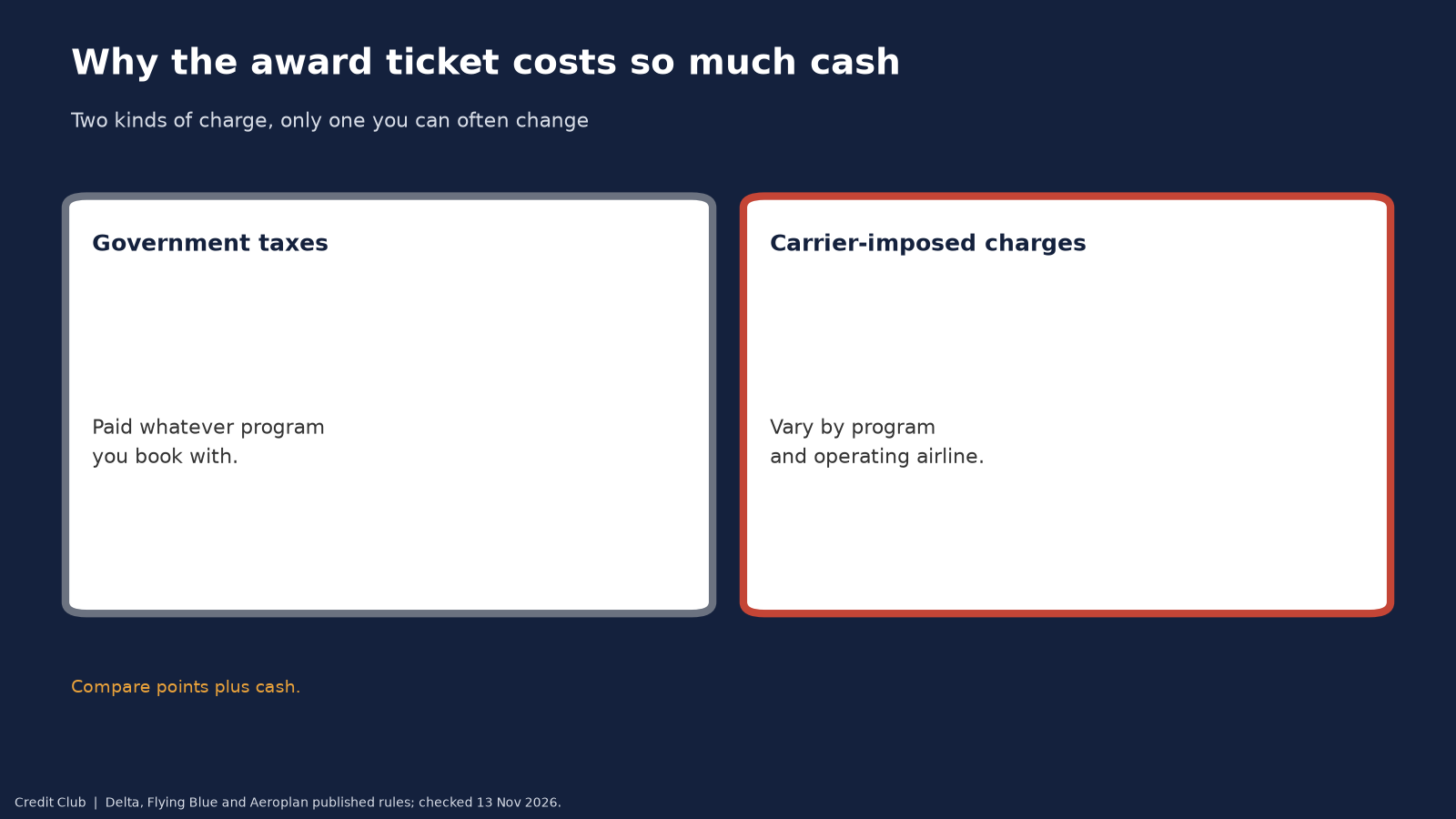
What we'd do first: on the booking screen, open the price breakdown. If you see a carrier-imposed charge, that's the part you can often change.
What the programs themselves say
- Delta SkyMiles: award redemption "requires payment of at least \$11.20 in U.S. government taxes and fees for domestic itineraries and may include up to \$600 for foreign government taxes and fees and/or carrier-imposed fees for international itineraries", and "Some airline partners impose a surcharge on Award redemptions" (Delta: Travel with Miles, checked 13 Nov 2026, 21:45 Lima). That \$600 is Delta's published upper figure in its rules, not a typical price.
- Flying Blue: "Reward tickets are subject to airport and security taxes and carrier surcharges. These taxes and surcharges are not covered by Miles and must be paid separately" (Flying Blue: reward tickets, checked 21:45 Lima).
- Aeroplan: a "CAD39 partner booking fee will apply, per ticket" when the reservation includes a flight operated by an airline other than Air Canada, Air Canada Express or Rouge, and phone bookings carry a CAD30 fee (Aeroplan Flight Reward Policy, checked 22:27 Lima). Aeroplan may also add a U.S. Tax Recovery Fee on certain itineraries.
- TSA: the September 11th Security Fee is \$5.60 per one-way trip, capped at \$11.20 per round trip (TSA: Security Fees, checked 13 Nov 2026, 21:45 Lima).
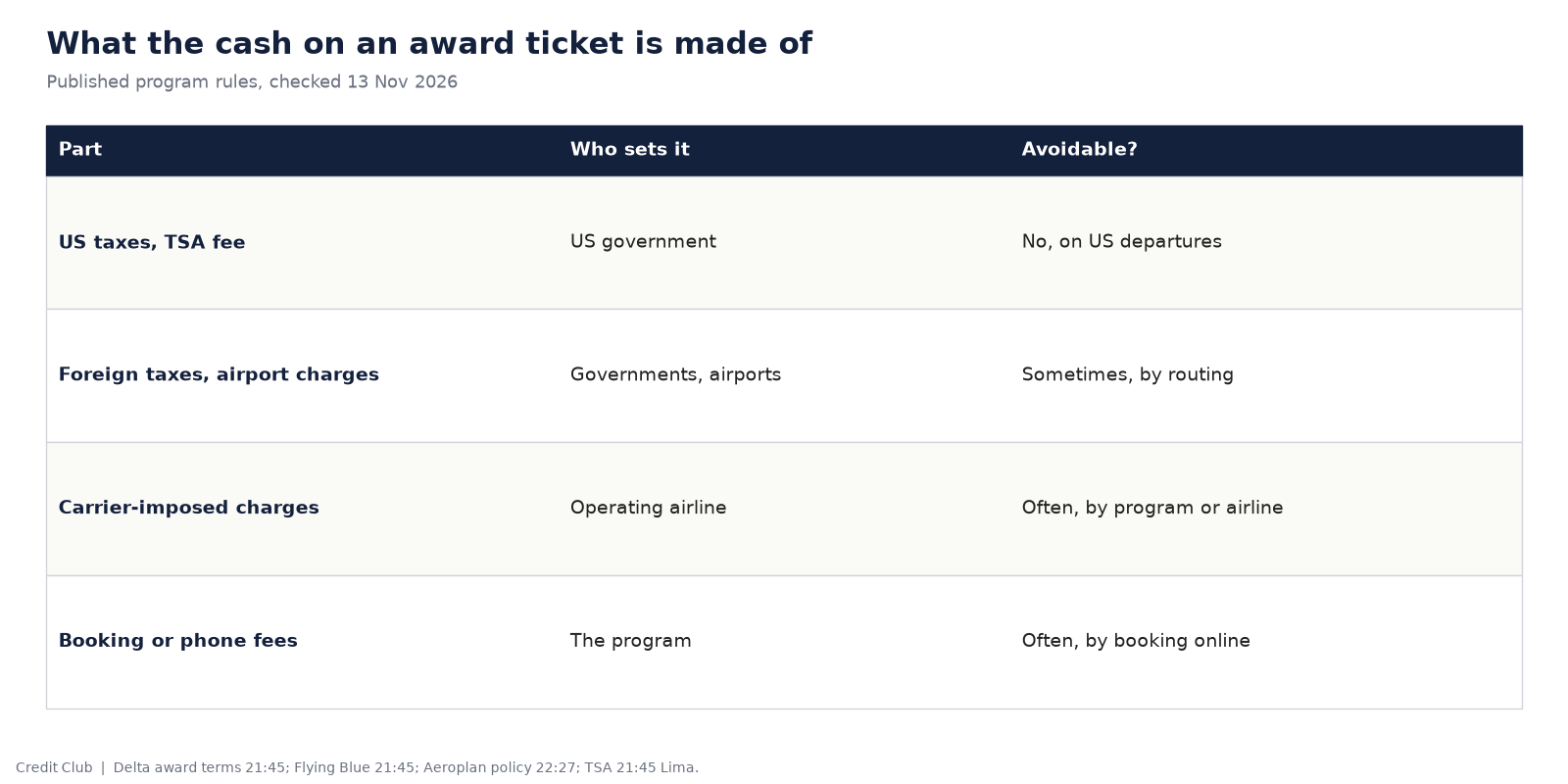
Taxes you can't avoid, charges you might
| Part of the cash | Who sets it | Can you avoid it? |
|---|---|---|
| US taxes and security fees | US government | No, on US departures |
| Foreign taxes and airport charges | Foreign governments and airports | Sometimes, by routing via another airport |
| Carrier-imposed charges | The operating airline, passed on by the program | Often, by changing program or airline |
| Booking or phone fees | The program | Often, by booking online |
The UK is the example most US travelers meet: departures from the UK carry Air Passenger Duty, a government tax, which is why a return from London often costs more cash than the outbound. That part is tax, so no program removes it. Starting the return from another European country can reduce it, though other countries have their own charges.
A worked comparison (hypothetical)
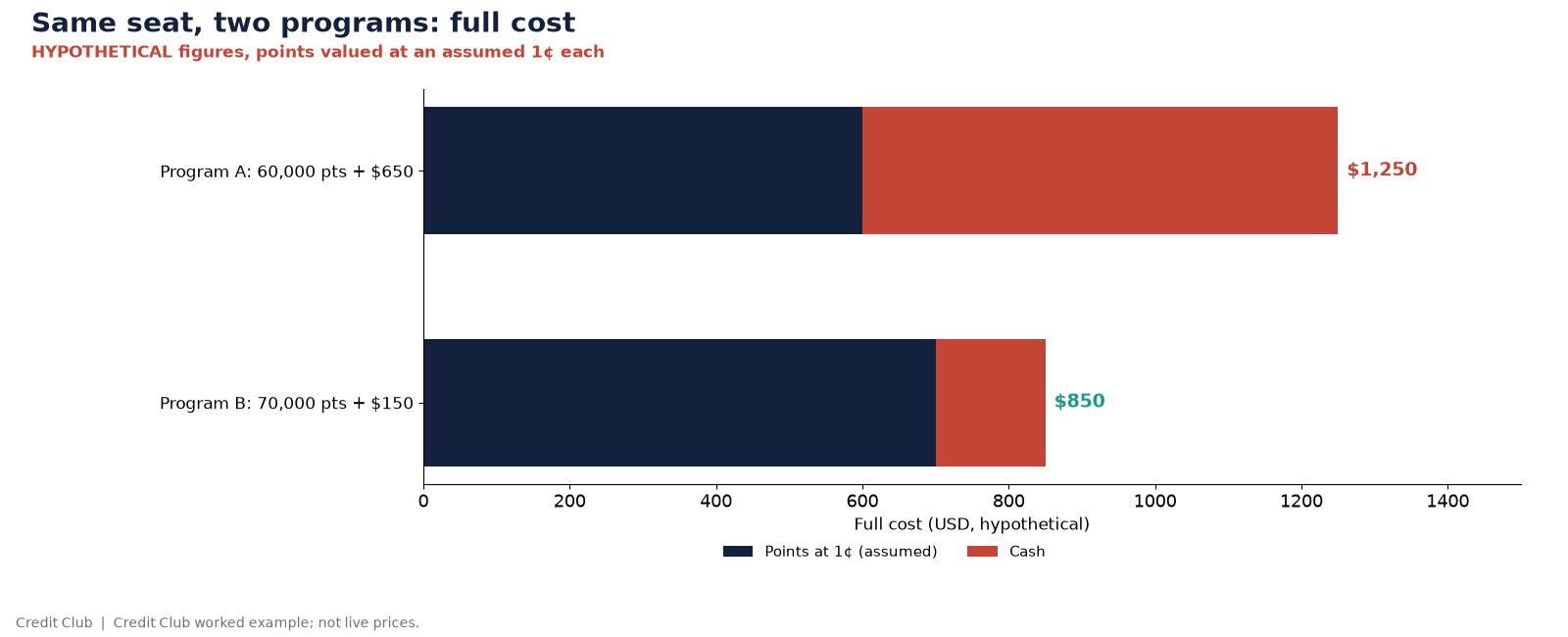
Same seat, two ways to book a one-way business class award from Europe to the US:
- Program A, which passes on the carrier's charges: 60,000 points + \$650 cash.
- Program B, which doesn't add carrier charges for that airline: 70,000 points + \$150 cash.
At an assumed 1¢ per point yardstick (our assumption, not a market value), Program A costs \$600 + \$650 = \$1,250 in total; Program B costs \$700 + \$150 = \$850. The trip with more points is the cheaper trip. All figures are hypothetical; programs, prices and charges vary by date and route.
Ways to pay less cash
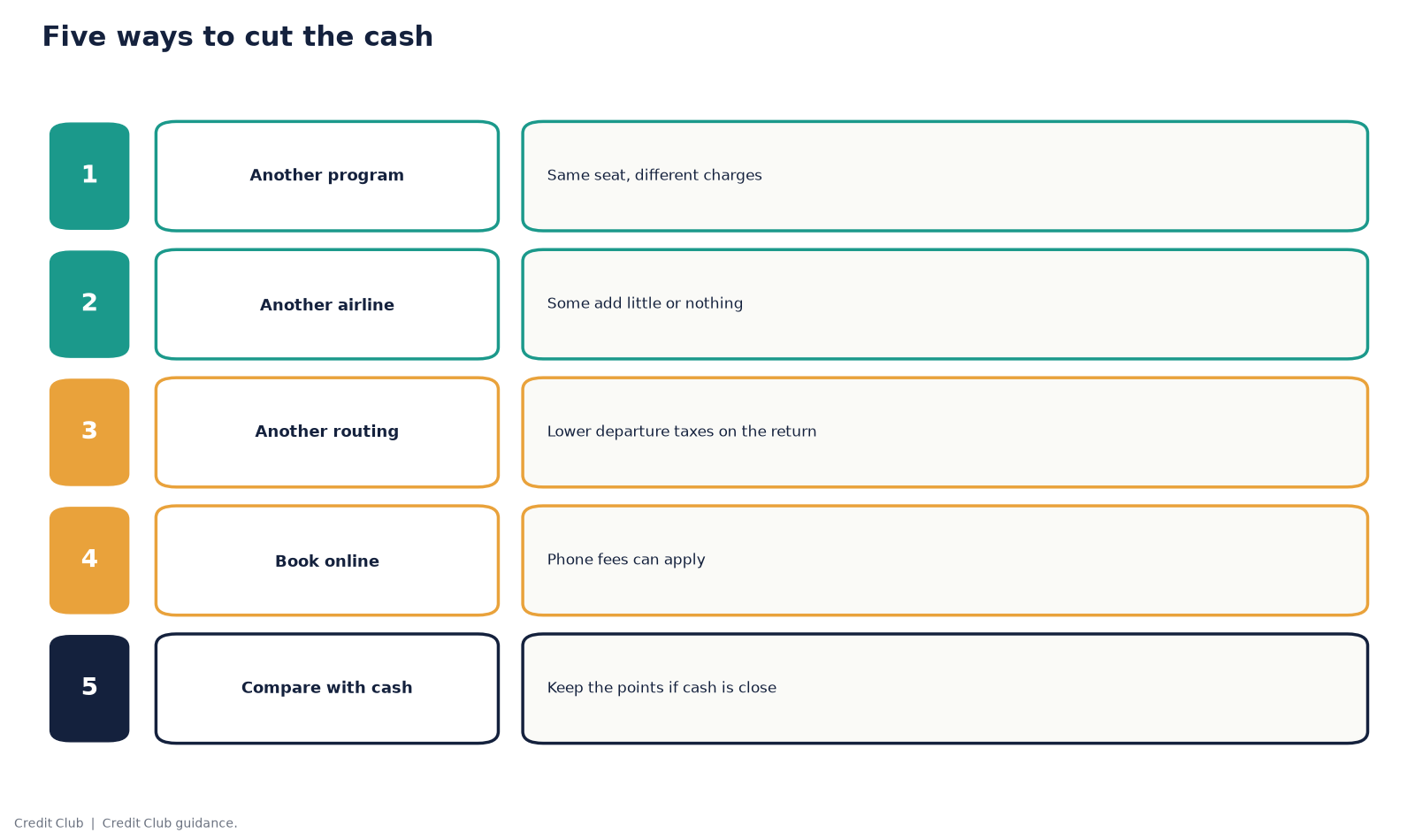
- Price it in another program. The same operating airline can carry different cash costs depending on the program you book with. If your points transfer to several programs, check two or three. Our guide to transferable points shows which programs each issuer reaches.
- Choose a different operating airline. Some carriers add large charges; others add little or none. A partner flight on a different airline in the same alliance can change the cash a lot.
- Change the routing. Starting the return in a country with lower departure taxes can help. Check the full price, including any positioning flight.
- Book online. Phone bookings can carry a fee; Aeroplan's policy quotes CAD30.
- Compare with cash. If the award cash plus points beats the cash fare only slightly, pay cash and keep the points. Our guide to points or cash for flights works through this.
How to read the price breakdown
Most booking screens show a "taxes, fees and charges" line you can expand. Look for:
- Tax lines named after a government or airport: expected.
- Carrier-imposed or fuel lines, often marked "YQ" or "YR": the part that varies most.
- Booking or service fees from the program: avoidable online, sometimes.
If the screen doesn't break it down, start the booking and check before paying, or ask the program for the breakdown.
Domestic awards: why the fees are small
On a US domestic award, the cash is usually just the TSA security fee and, depending on the program, a few dollars of other US charges. Delta's rules put the minimum at \$11.20 for domestic itineraries. If a domestic award shows much more than that, check whether you've picked a partner flight, a phone booking or a fare that adds a program fee.
When high fees are still worth paying
A large cash portion isn't automatically a bad deal. If the seat is the only one available on your date, or the cash fare is several thousand dollars, paying \$500 on top of the points can still be the best option. The test is the full cost: points valued at a yardstick you choose, plus cash, compared with the cash fare and with the next-best award. Our guide to award charts and dynamic pricing explains why prices move.
Mistakes to avoid
- Comparing points only. A cheaper-in-points award can be the dearer trip once cash is added.
- Transferring before checking the cash. Transfers are final; check the full price before you move points.
- Ignoring the return. The leg home from Europe often carries the higher taxes.
- Booking by phone by default. Online booking can avoid a program fee.
Trade-offs
- More points, less cash suits people who have plenty of points and want to spend less money.
- Fewer points, more cash can suit people saving points for a bigger trip, if the cash is affordable.
- Positioning to save on taxes adds time, risk and sometimes a hotel night.
- Partner availability differs by program; the cheaper-cash option may have no seat on your date.
Fallback
If every program adds high charges on your route, try a different airline, shift dates, or compare with a cash fare and a cents-per-point check. Sometimes paying cash is the better use.
Award fees: FAQs
Why is the return from London more expensive?
UK departures carry Air Passenger Duty, a government tax, plus airport charges. Some programs also add carrier charges.
Are fuel surcharges the same as taxes?
No. Taxes come from governments; carrier-imposed charges come from airlines and vary by program.
Can I pay the fees with points?
Some programs allow it. Aeroplan's policy says taxes and fees "may be paid wholly in points or wholly in cash" on fares paid wholly in points.
Do I get the fees back if I cancel?
Programs set their own rules. Aeroplan says cancellations "may provide a refund of taxes, fees and charges on any unused value of travel", except taxes non-refundable by law; a cancellation fee may apply.
Do card issuers' travel portals add surcharges?
Portal bookings are usually priced as cash fares, so there's no separate award surcharge, but the fare itself includes the airline's charges. Compare the total.
Will fees be lower if I book earlier?
Not reliably. Taxes follow the route; carrier charges follow the airline and program, and can change at any time.
Is a \$5.60 fee on a domestic award normal?
Yes. That's the TSA security fee per one-way trip, published by TSA.