
On this page
- How transferable points work
- The five currencies at a glance
- Who transfers where: airlines
- Who transfers where: hotels
- Which to build first: start from your home airport
- A worked example: is this redemption worth it? (hypothetical)
- Transfers versus portals versus cash back
- Trade-offs
- If no currency fits
- Transferable points: FAQs
Transferable points are card rewards you can move into airline and hotel loyalty programs, usually at 1:1. The five big US currencies are American Express Membership Rewards, Chase Ultimate Rewards, Capital One miles, Citi ThankYou Points and Bilt Points. Which to build first depends mostly on where you fly from: start with the currency that transfers to the airline that dominates your home airport, then check it also reaches a hotel program you'd use.
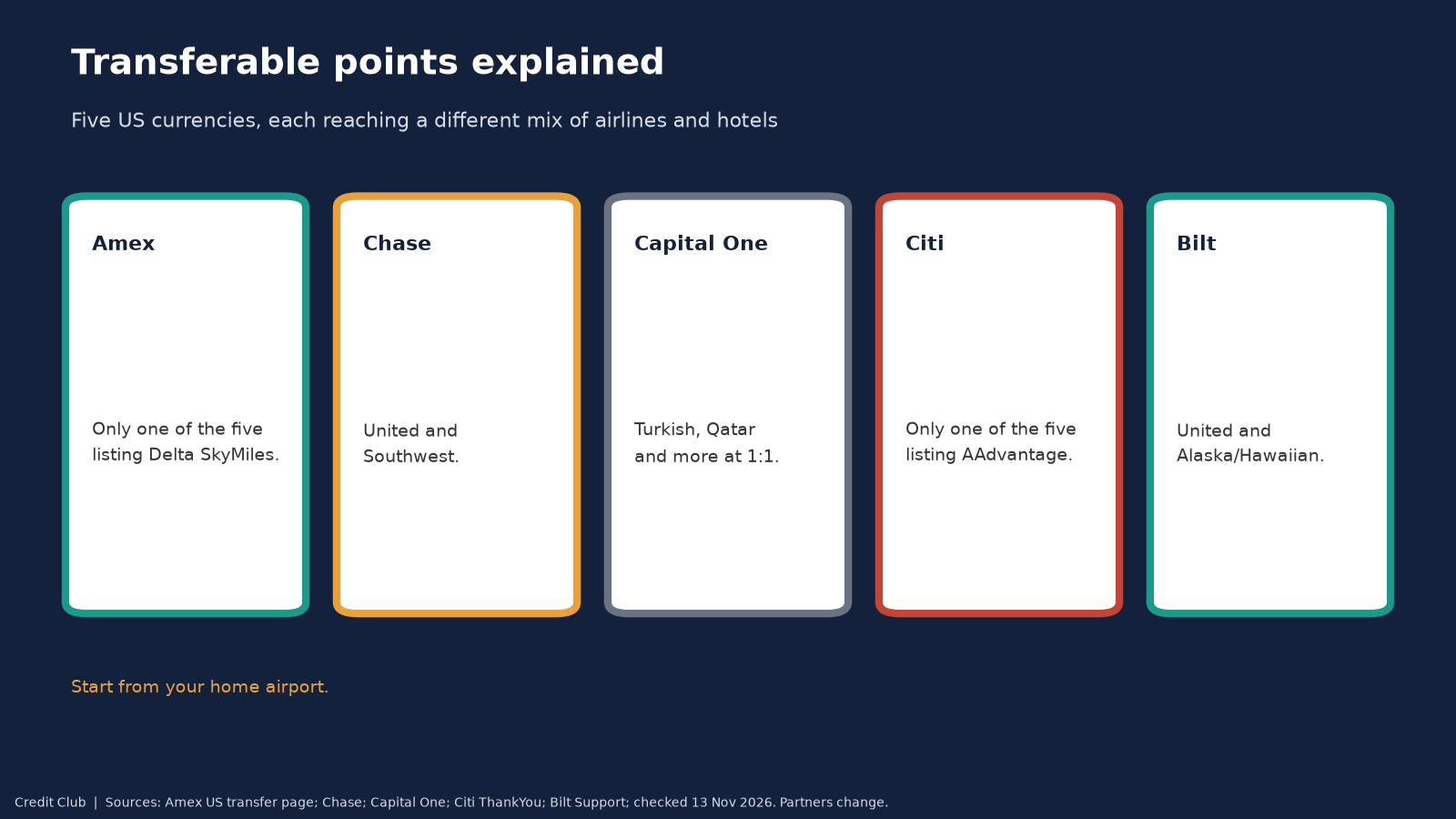
What we'd do first: write down your home airport and the two airlines you fly most. Then check the partner table below for which currencies reach them.
How transferable points work
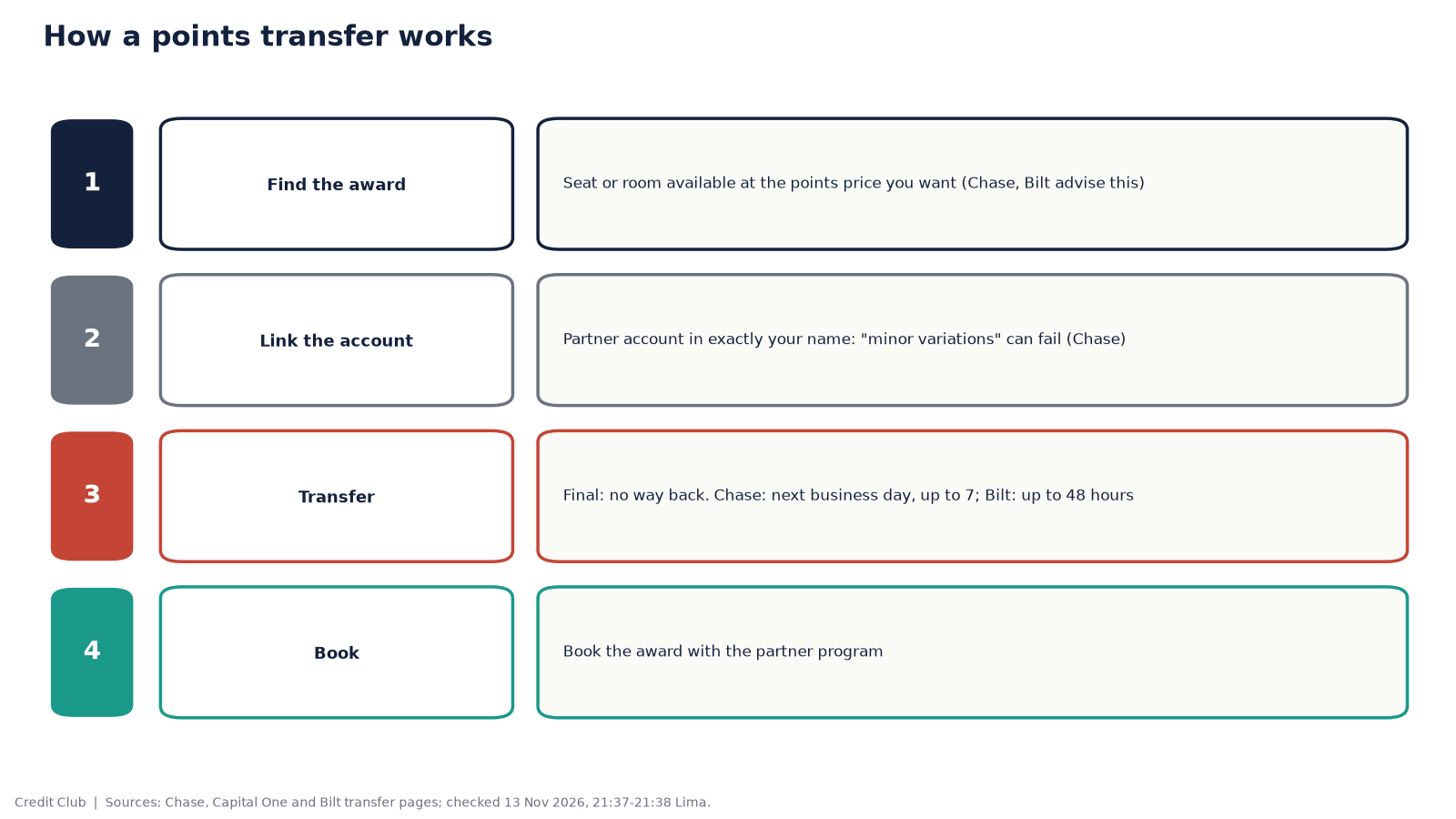
You earn points with a card. When you want to book, you move them from the card program into a partner program, such as United MileagePlus or Marriott Bonvoy, and book the award there. Three things apply across all five issuers:
- Transfers are final. Capital One says "there's no way to transfer miles back into your Capital One rewards account once the transfer is finalized" (Capital One: miles transfer partners, dated Nov 2, 2026, checked 13 Nov 2026, 21:37 Lima). Bilt says transfers "cannot be reversed" (Bilt Rewards Support: Bilt's Transfer Partners, updated Oct 20, 2026, checked 13 Nov 2026, 21:38 Lima). Chase calls them "final" (Chase: How to transfer Ultimate Rewards points, checked 13 Nov 2026, 21:37 Lima).
- Names must match. Chase says "Even minor variations could result in transfer failure". Capital One says the names "has to match".
- Find the seat first. Chase suggests you "make sure the award is available" before transferring. Bilt recommends "confirming the flight or hotel availability with the loyalty partner prior to transferring points".
Timing differs. Chase says "many point transfers process by the next business day, they may take up to 7 business days". Bilt says "In most cases, transfers will be immediate, but please allow up to 48 hours", and up to 72 hours for Southwest.
The five currencies at a glance
| Amex Membership Rewards | Chase Ultimate Rewards | Capital One miles | Citi ThankYou Points | Bilt Points | |
|---|---|---|---|---|---|
| Usual ratio | Mostly 1:1; some partners differ | 1:1 to most; World of Hyatt 4:3 | Mostly 1:1; some 2:1.5 or 5:3 | Not shown on the public listing | Mostly 1:1 |
| Minimum or increment | Mostly 1,000-point increments | Increments of 1,000 | At least 1,000 miles | Check at transfer | 1,000-point increments; 2,000 minimum at Blue status |
| Cards that can transfer | Cards earning Membership Rewards | Sapphire Preferred, Sapphire Reserve, Ink Business Preferred | Capital One travel or business rewards cards | Eligible cardholders | Bilt members |
Sources: American Express: Transfer points (checked 13 Nov 2026, 21:32 Lima); Chase, Capital One and Bilt pages above; Citi ThankYou: Points Transfer (checked 13 Nov 2026, 21:32 Lima).
Who transfers where: airlines
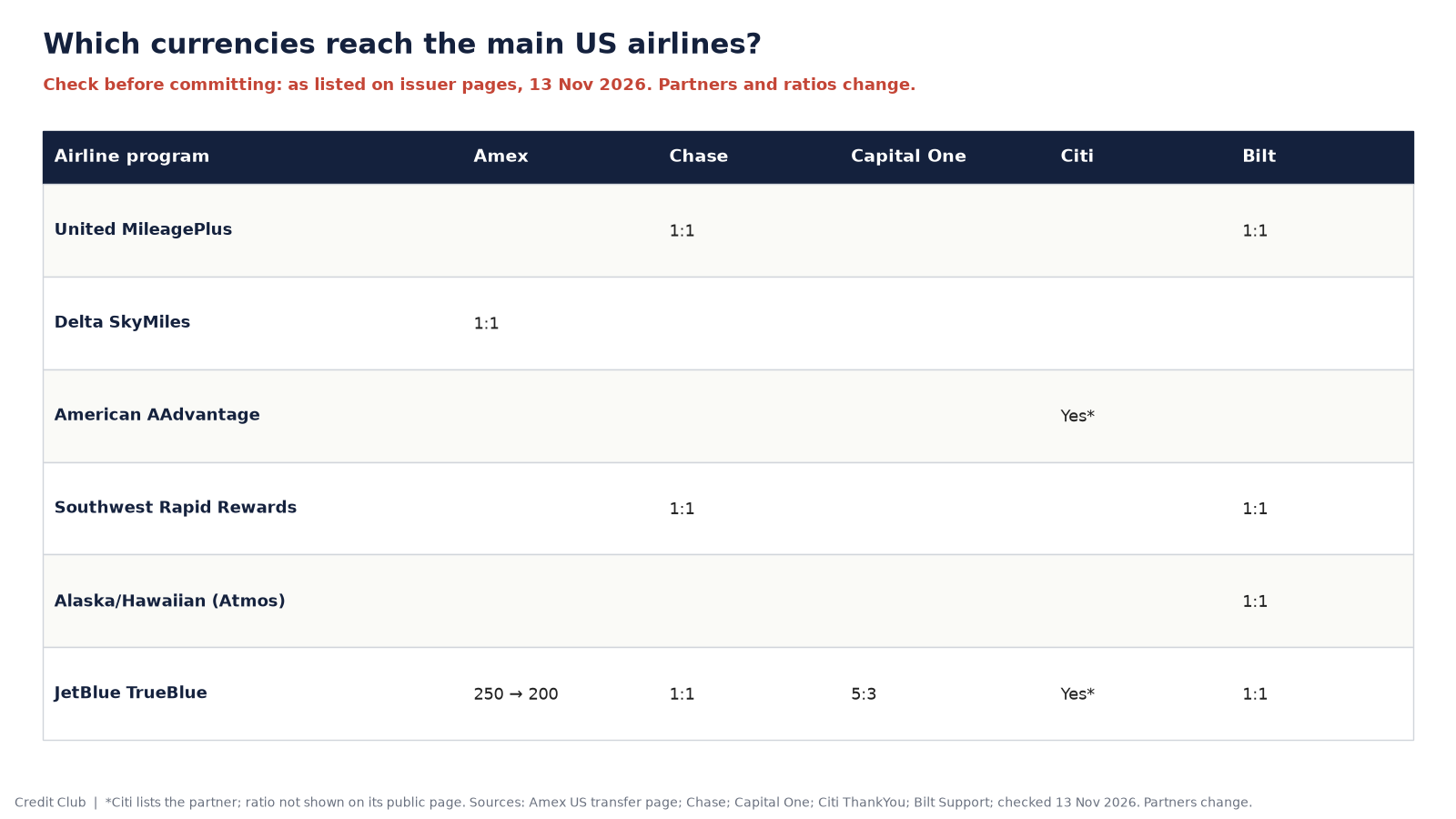
This is what each issuer's page listed when we checked. Partners change, so confirm on the issuer's page before you rely on one.
| Airline program | Amex | Chase | Capital One | Citi | Bilt |
|---|---|---|---|---|---|
| United MileagePlus | 1:1 | 1:1 | |||
| Delta SkyMiles | 1:1 | ||||
| American AAdvantage | Yes | ||||
| Southwest Rapid Rewards | 1:1 | 1:1 | |||
| Alaska/Hawaiian (Atmos Rewards) | 1:1 | ||||
| JetBlue TrueBlue | 250 → 200 | 1:1 | 5:3 | Yes | 1:1 |
| Air Canada Aeroplan | 1:1 | 1:1 | 1:1 | 1:1 | |
| Air France-KLM Flying Blue | 1:1 | 1:1 | 1:1 | Yes | 1:1 |
| British Airways Club | 1:1 | 1:1 | 1:1 | 1:1 | |
| Virgin Atlantic Flying Club | 1:1 | 1:1 | 1:1 (Virgin Red) | Yes | 1:1 |
| Singapore KrisFlyer | 1:1 | 1:1 | 1:1 | Yes | |
| Emirates Skywards | 1,000 → 800 | 2:1.5 | Yes | 1:1 | |
| Qatar Privilege Club | 1:1 | 1:1 | Yes | 1:1 | |
| Turkish Miles&Smiles | 1:1 | Yes | 1:1 |
"Yes" means Citi lists the partner but its public page didn't show the ratio when we checked; you'll see it on the transfer screen. Blank means the partner wasn't on that issuer's list. Each issuer has more partners than shown here.
Who transfers where: hotels
| Hotel program | Amex | Chase | Capital One | Citi | Bilt |
|---|---|---|---|---|---|
| Marriott Bonvoy | 1:1 | 1:1 | 1:1 | ||
| Hilton Honors | 1,000 → 2,000 | 1:1 | |||
| World of Hyatt | 4:3 | 1:1 | |||
| IHG One Rewards | 1:1 | 1:1 | |||
| Accor | 2:1 | Yes | 3:2 | ||
| Wyndham Rewards | 1:1 | 1:1 | Yes | 1:1 | |
| Choice Privileges | 1:1 | 1:1 | Yes |
Chase's Sapphire Preferred page explains the Hyatt ratio: "if you transfer 1,000 Ultimate Rewards® points, you will get 750 World of Hyatt points" (Chase Sapphire Preferred benefits, checked 13 Nov 2026, 21:42 Lima). For the details and exceptions, see Chase points and Hyatt.
Which to build first: start from your home airport
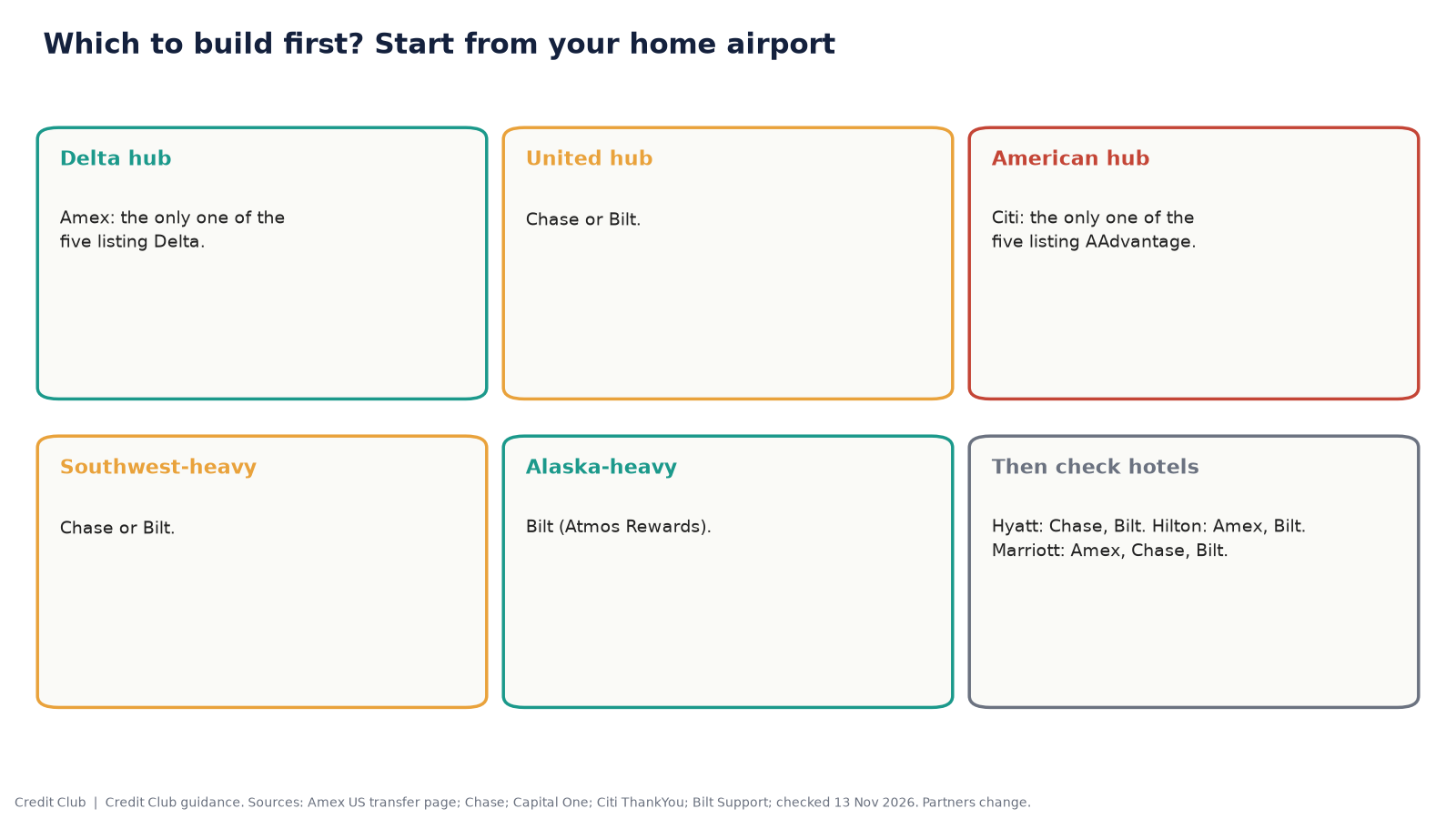
The airline that runs most flights from your airport is often the one whose miles you'll use most. Using the tables above:
- Delta hub (for example Atlanta, Detroit, Minneapolis): only Amex, of these five, lists Delta SkyMiles.
- United hub (for example Chicago O'Hare, Denver, Houston, Newark, San Francisco): Chase and Bilt both list United.
- American hub (for example Dallas/Fort Worth, Charlotte, Miami): only Citi, of these five, lists AAdvantage.
- Southwest-heavy airports: Chase and Bilt list Southwest.
- Alaska-heavy airports (for example Seattle): Bilt lists Atmos Rewards (Alaska and Hawaiian).
Then think about international trips and hotels. Most of the five reach Air Canada Aeroplan, Flying Blue and British Airways Club, which can book many partner flights. For hotels, Chase and Bilt reach Hyatt; Amex and Bilt reach Hilton; Amex, Chase and Bilt reach Marriott.
Annual fees matter too. As examples from the issuers' own pages: Chase lists the Sapphire Preferred at a "$95 annual fee", and Capital One describes the VentureOne as having "no annual fee". Check each card's current rates and fees page before applying; we don't recommend a specific card here.
A worked example: is this redemption worth it? (hypothetical)
Every number is hypothetical. We value points at an assumed 1 cent each as a yardstick; that's a planning assumption, not a market price.
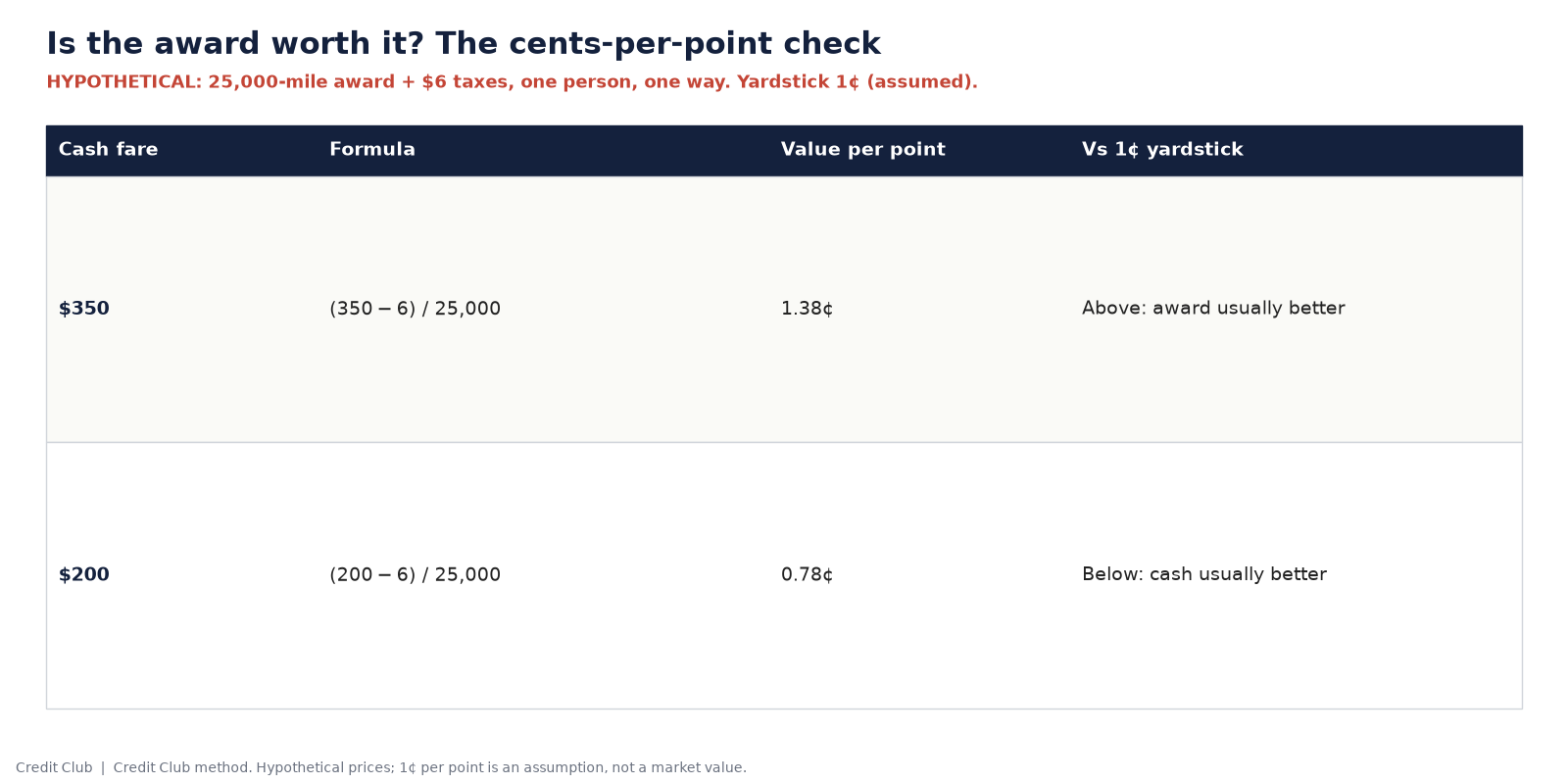
You live near Chicago and find a domestic one-way economy United award for 25,000 miles plus $6 in taxes, for one person (hypothetical). The same flight costs $350 in cash (hypothetical).
- Points needed: 25,000 Chase or Bilt points, transferred 1:1.
- Value per point: ($350 − $6) ÷ 25,000 = 1.38 cents.
- Against our yardstick: 1.38 cents is above 1 cent, so on these numbers the award is better than paying cash.
- For two travelers: 50,000 points + $12, against $700 cash.
If the cash fare were $200, the value would drop to ($200 − $6) ÷ 25,000 = 0.78 cents, below the yardstick, and paying cash would usually make more sense. Our cents-per-point guide covers the full method, including lost cash back.
Transfers versus portals versus cash back
Transferring isn't the only way to use these points. Each issuer also lets you book paid travel through its own portal or use points against travel you've already charged. Capital One, for example, lists booking through Capital One Travel and covering "recent travel purchases" among its options. Chase says that "as a general rule of thumb, one point equates to $0.01 in redeemable value", though it "can fluctuate" depending on how you redeem (Chase: How to use Ultimate Rewards for travel, checked 13 Nov 2026, 21:44 Lima).
The difference is where the value comes from. A portal booking turns points into a cash-like discount at a rate the issuer sets, so you get roughly the same value whatever you book. A transfer turns them into airline miles or hotel points, whose value depends entirely on the award price. That's why transfers can be worth much more on some bookings, and much less on others. If you won't search for awards, a portal or plain cash back is simpler and avoids the risk of moving points to a program you then can't use.
Trade-offs
- Reach versus focus. One currency with the right airline partner beats several half-built balances.
- Ratios aren't all 1:1. Amex to Emirates is 1,000 → 800, Capital One to JetBlue is 5:3, Chase to Hyatt is 4:3. Fewer partner points can still be good value if the award is cheap.
- Transfer timing. Some transfers are near-instant; others take days. A seat can go while you wait. See points transfer delayed.
- Bonuses come and go. Issuers run transfer bonuses from time to time. Judge one against the award you need; see are transfer bonuses worth it.
If no currency fits
If your home airline isn't on any list, a co-branded airline card or simply cash back may serve you better. You can also redeem through an issuer's travel portal, which books paid fares with points; the value is set by the issuer.
Transferable points: FAQs
Can I move points back after a transfer?
No. All the issuers we checked say transfers are final.
Do transferred points expire?
Once transferred, they follow the partner program's rules.
Should I hold more than one currency?
Only once the first is doing its job. Two currencies that reach different airlines can be useful; two that reach the same ones less so.