
On this page
An award chart tells you in advance what a seat or room costs in points, usually by distance, region or hotel category. Dynamic pricing moves the points price up and down with demand, much like a cash fare. Charts don't guarantee you'll find a seat, but they make it easy to spot a good deal and to price the same flight in a cheaper program. Among the programs we checked, Aeroplan publishes fixed partner prices by distance, World of Hyatt keeps a published hotel chart, and American publishes estimated starting values for partner flights; Delta and American's own flights price closer to demand.
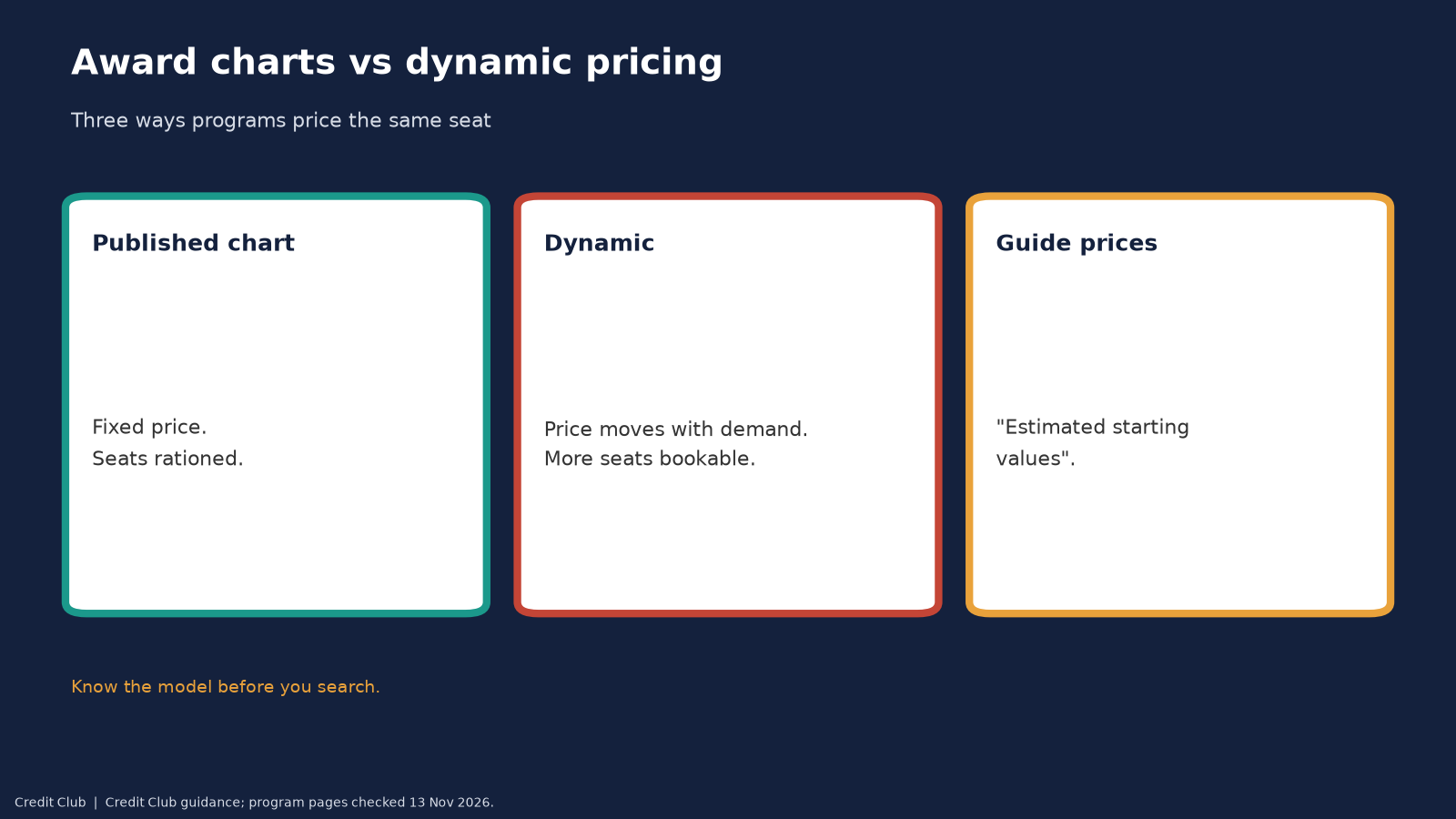
What we'd do first: before you search, find out which model the program you're looking at uses. If it publishes a chart, look up the price for your route; that's your target. If it's dynamic, search the program's flexible-date calendar and note the lowest price across several days.
What a chart is, and what it isn't
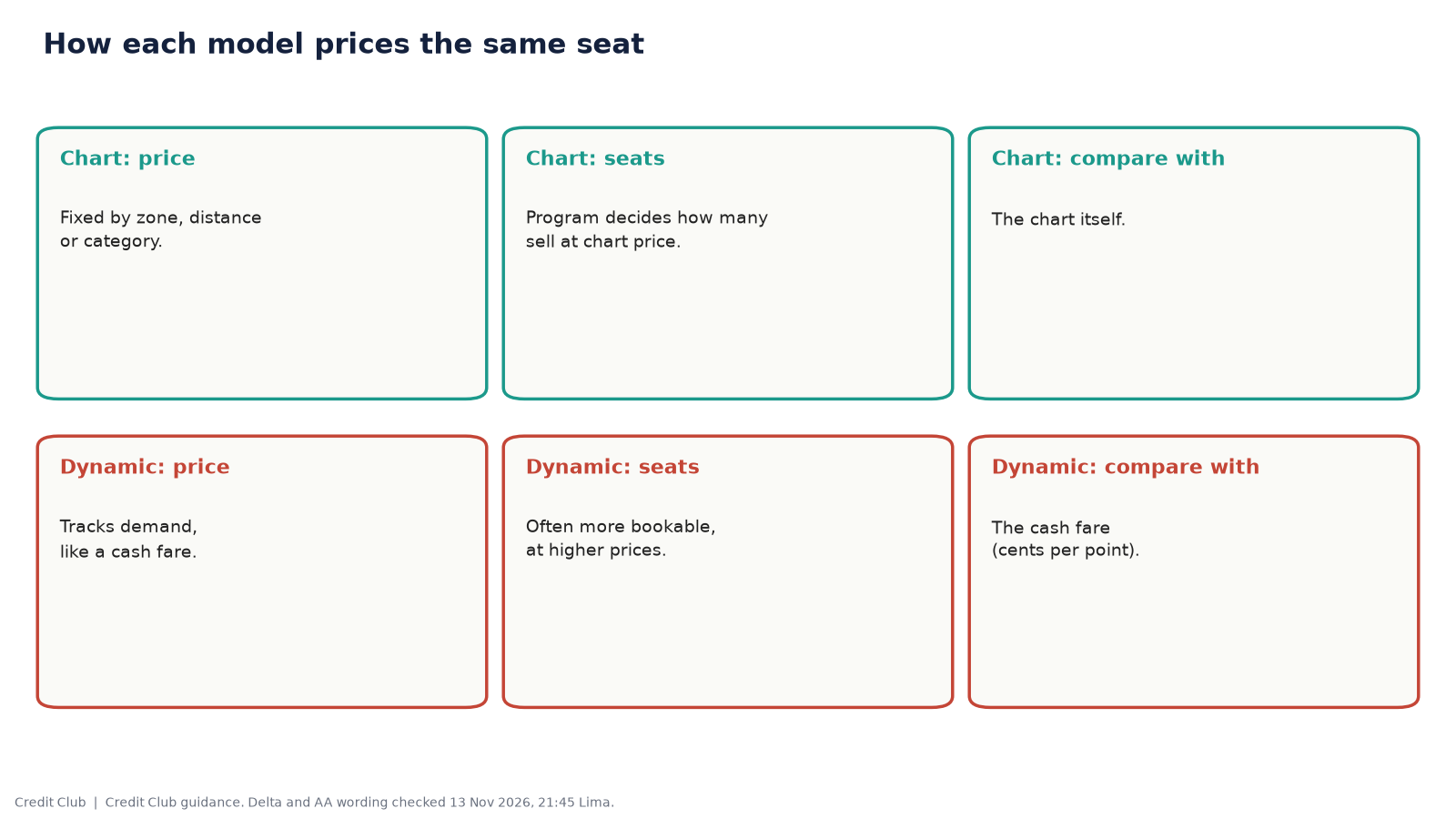
A traditional award chart lists a fixed points price for a zone, distance band or hotel category. If a seat is released at that level, you pay that price, whatever the cash fare is that day. The catch is availability: programs choose how many seats or rooms to release at chart prices, and the best ones often go first.
A chart is not a promise that a seat exists. It's a promise about the price if one does. That still matters, because it lets you work backwards: if you know an award should cost 60,000 points, any search that shows 120,000 points tells you to look elsewhere, not to pay up.
What dynamic pricing changes
With dynamic pricing, the program sets the points price per flight, often tracking the cash fare and demand. Delta's award page says its "flexible Award calendar shows the lowest price options for the dates you select", and that "Awards are subject to capacity controls. Awards may require higher prices depending on routing rules and restrictions" (Delta: Travel with Miles, checked 13 Nov 2026, 21:45 Lima).
American's terms describe a hybrid for its own flights: AA-operated flights "may be used for any available seat on a flight, including the last seat, however, the number of miles required for a flight award may be higher depending on the availability" (AAdvantage terms and conditions, effective March 1, 2026, section E.7, checked 13 Nov 2026, 21:45 Lima).
The upside of dynamic pricing is access: more seats are bookable, at a price. The downside is predictability. There's no number to aim for, so you have to compare against the cash fare, using the cents-per-point method.
Which programs still publish charts
These are the positions we found on official pages on 13 November 2026. Programs change their pricing, so check before committing.
Aeroplan (Air Canada). Aeroplan's Flight Reward Chart (dated 2026-08) splits pricing in two. For Air Canada and "Select Partners" (it names United, Emirates, Flydubai, Etihad and several regional carriers) it shows "starting at" prices plus median prices. For "all other partners" it shows a single price per distance band. The chart says "Points required for flight rewards are based on the actual distance flown between origin and destination", that a "partner booking fee will apply" to partner awards, and that points "varies depending on the travel itinerary and travel during high-demand periods" (Aeroplan Flight Reward Chart, PDF, checked 13 Nov 2026, 21:47 Lima). Between North America and Europe (Aeroplan's "Atlantic" zone), the published business price on other partners is 60,000 points one way for 0–4,000 miles and 75,000 for 4,001–6,000 miles. On Air Canada and Select Partners the business "starting at" price in the lower band is also 60,000, but the chart lists a median of 133,800 points, a good illustration of how far variable prices can sit above the floor.
World of Hyatt. In a February 25, 2026 release, Hyatt said it is "continuing to operate with fixed point thresholds rather than moving to dynamic pricing for award nights", while expanding "from three to five redemption levels within each of its existing eight categories" starting in May, named Lowest, Low, Moderate, Upper and Top (Hyatt newsroom, February 25, 2026, checked 13 Nov 2026, 21:48 Lima). So Hyatt still publishes its prices, but a given hotel can now sit at more levels across the year. Check the live chart on hyatt.com for current category prices.
American AAdvantage partner awards. American publishes partner prices as a guide: "Miles shown are estimated starting values for one-way trips originating in the country / region selected, for informational purposes only. Two flight awards are needed if your one-way trip includes two long-haul international flights" (AAdvantage: partner airline flights, checked 13 Nov 2026, 21:45 Lima). That's closer to a chart than to dynamic pricing, but "estimated starting values" isn't a fixed price.
Flying Blue (Air France-KLM). Flying Blue shows "Starting from" prices and monthly Promo rewards with "up to 25%" off selected routes (Flying Blue: reward tickets, checked 13 Nov 2026, 21:47 Lima). We treat this as variable pricing with a published floor rather than a chart.
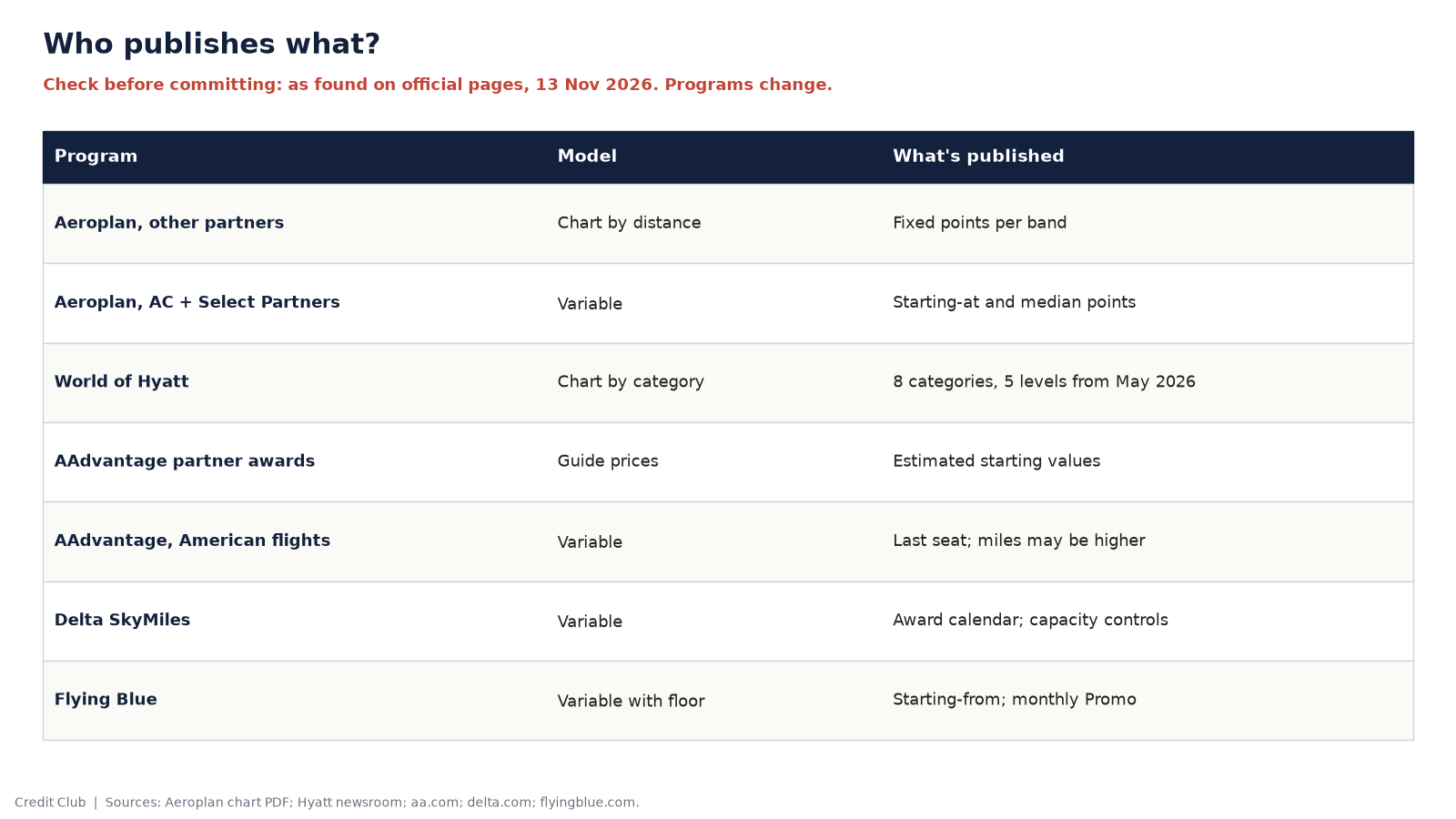
| Program (as checked 13 Nov 2026) | Model | What's published |
|---|---|---|
| Aeroplan, "all other partners" | Chart by distance | Fixed points per distance band |
| Aeroplan, Air Canada and Select Partners | Variable | "Starting at" and median points |
| World of Hyatt | Chart by category | Eight categories, five levels from May 2026 |
| AAdvantage partner awards | Guide prices | "Estimated starting values" |
| AAdvantage flights on American | Variable | Last-seat access; miles may be higher |
| Delta SkyMiles | Variable | Award calendar; capacity controls |
| Flying Blue | Variable with floor | "Starting from" prices; monthly Promo rewards |
Worked example: one route, two programs (published starting prices and hypothetical figures)
Say you want business class from New York to Paris, one traveler, one way.
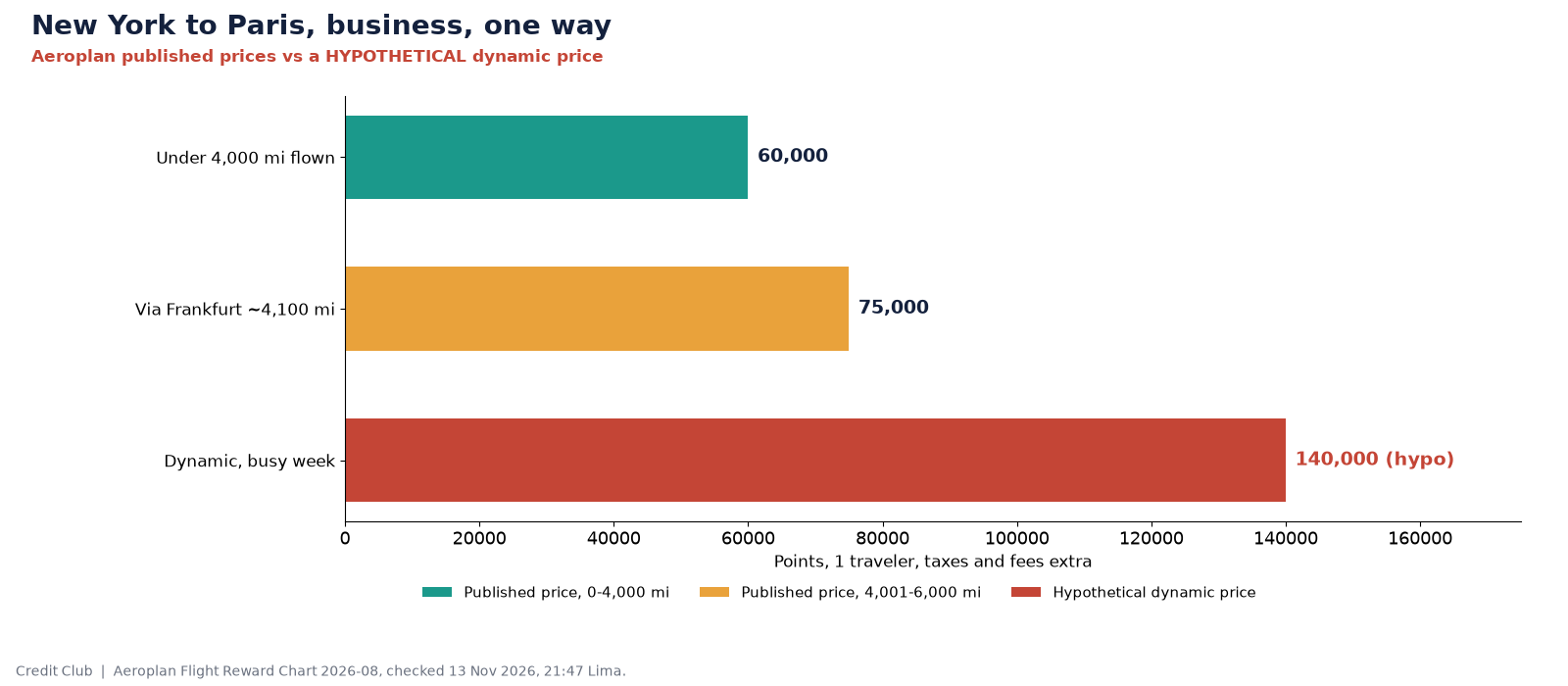
- Aeroplan, under 4,000 miles flown: a nonstop from the New York area to Paris (roughly 3,600 miles) or a connection via Montreal (about 3,750) falls in the 0–4,000-mile band, where the published business price is 60,000 points: a fixed price on most partners, and a "starting at" price on Air Canada and Select Partners such as United. Add taxes and, on partner flights, the booking fee shown at checkout.
- Aeroplan, connecting via Frankfurt on a non-Select partner: the distance flown rises to about 4,100 miles, which moves the same trip into the 4,001–6,000 band: 75,000 points (published chart price). The connection costs you 15,000 points because Aeroplan prices by distance flown.
- A dynamically priced program on the same day: suppose it shows 140,000 miles for a business seat in a busy week (hypothetical). Without a chart to compare against, you might assume that's normal. With the chart, you know the same cabin can price from 60,000 elsewhere if a seat is released at that level.
The lesson isn't that charts are always cheaper. On a quiet date, a dynamic program can undercut the chart. The lesson is that a chart gives you a reference price, and reference prices make it easier to say no.
Trade-offs
- Charts: predictable, but rationed. You know the price, but programs decide how many seats sell at it. Popular dates can show nothing at chart level.
- Dynamic: available, but unpredictable. You can usually find something, at a price that may be far above what the same seat costs elsewhere.
- Charts change too. Aeroplan announced chart changes for bookings from June 1, 2026 (Aeroplan news: an update on the Flight Reward Chart, official page seen via search index on 13 Nov 2026, 21:47 Lima; check before committing), and Hyatt added levels in May. A published price is only fixed until the next update.
- Partner fees and surcharges. A chart price in points may still come with a booking fee and taxes or carrier surcharges. Include them, as in our cents-per-point guide.
- Distance rules can surprise you. With distance-based charts, a connection can push a trip into a higher band.
How to use both
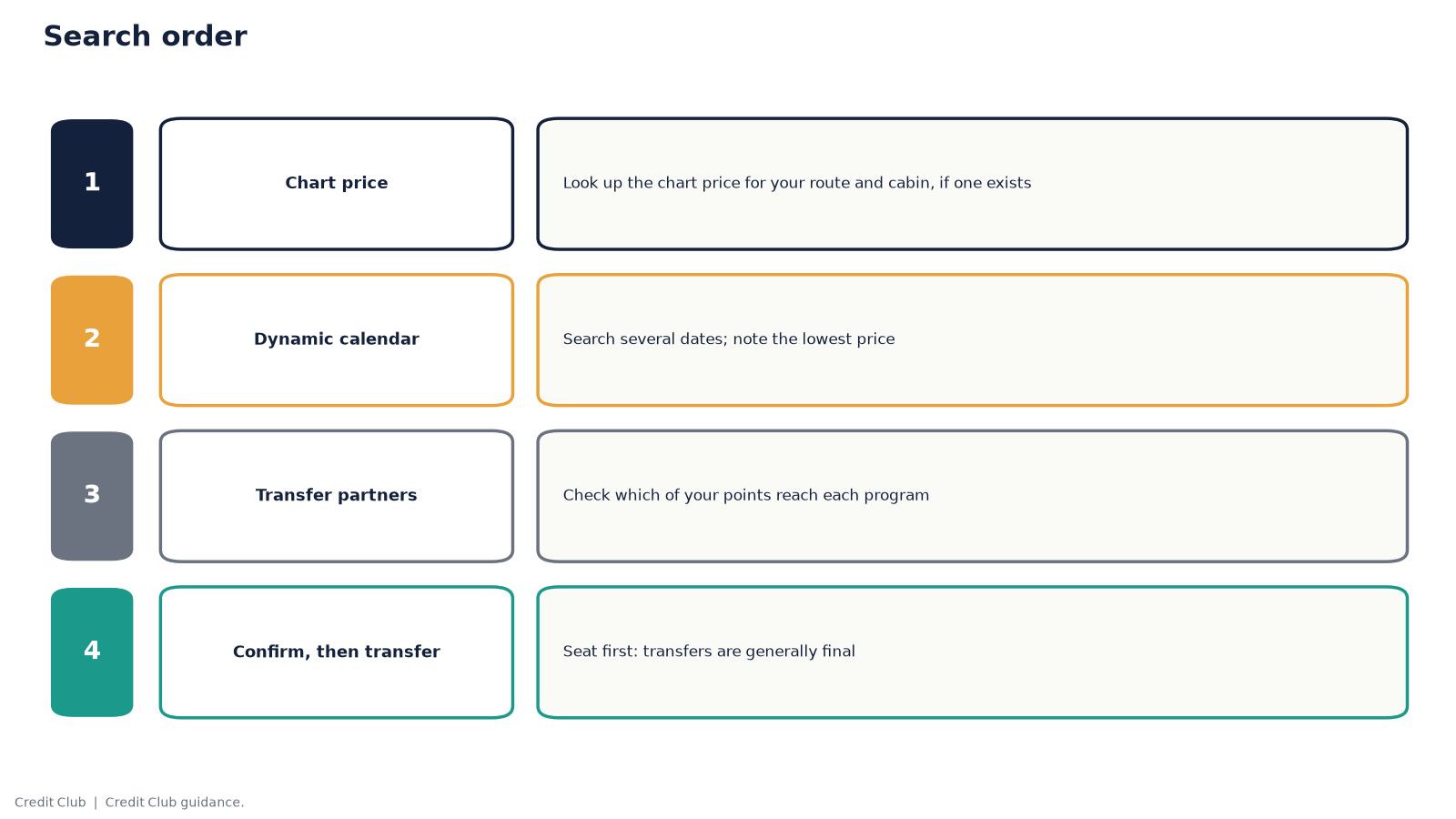
- Look up the chart price, if one exists, for your route and cabin.
- Search the dynamic program's calendar across several dates.
- Check which of your transferable currencies reach each program, using our transferable points explained guide.
- Confirm the seat in the program you'll book with before transferring anything. Transfers are generally final.
If neither works
If the chart program shows nothing and the dynamic price is poor value, try flexible dates, a nearby departure airport, or a different partner airline. If that fails, pay cash or use points at a fixed value; see when cash beats points.
Award charts: FAQs
Do any US airlines still publish award charts?
On the official pages we read, Delta and American's own flights price variably. American publishes estimated starting values for partner flights. Programs change often, so check the program's current pages.
Is a chart always better?
No. It's more predictable. Whether it's better depends on whether a seat is released at chart level on your date.
Why does a connection cost more on Aeroplan?
Because its chart prices by the actual distance flown, so a longer routing can move you into a higher band.
Are hotel charts going away?
Not at Hyatt, which said in February 2026 that it is keeping fixed point thresholds. Other chains differ.